Is Brain Aging a Failure of Mitochondrial Cooperation?

- Details
- Published on 03 September 2026
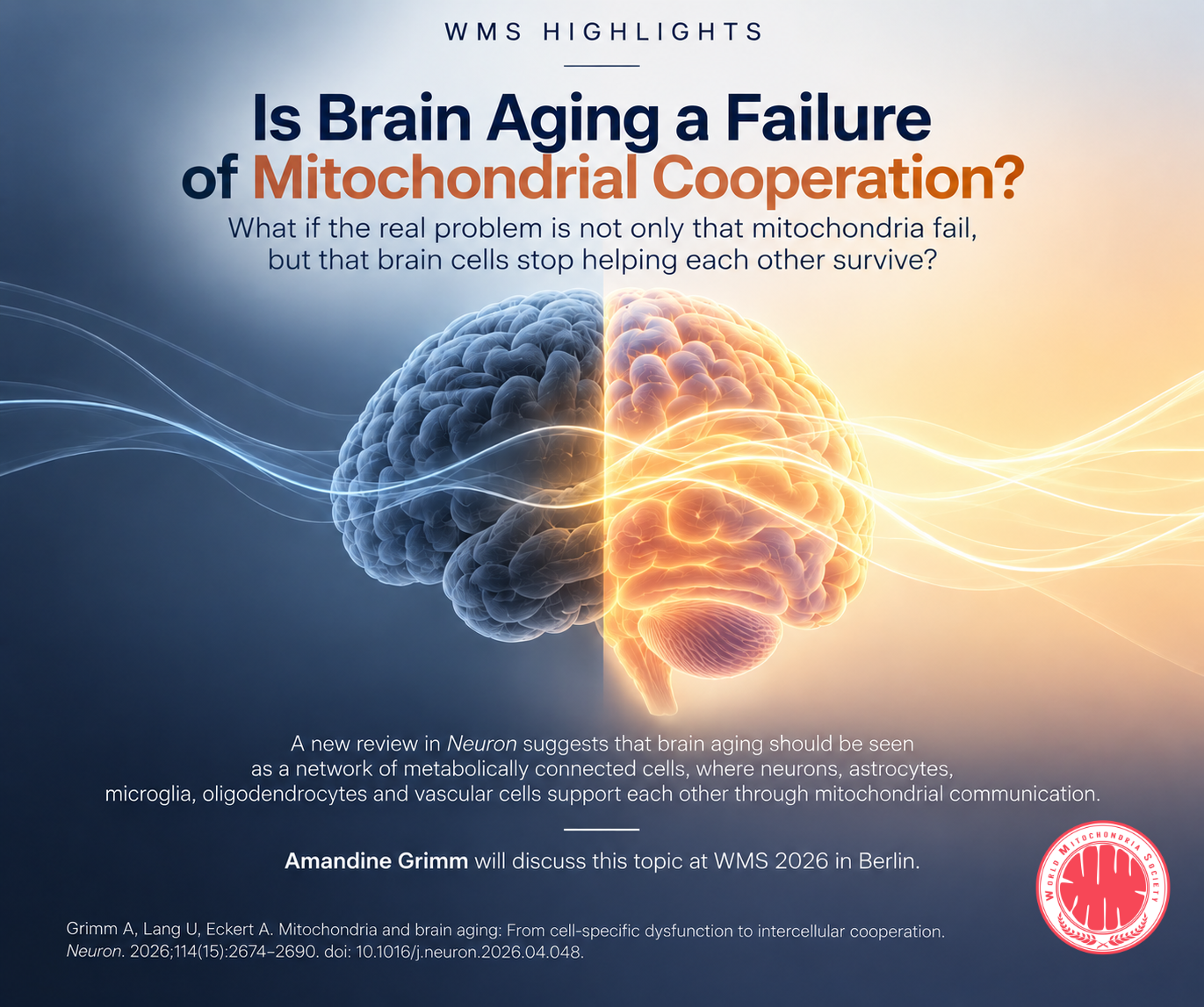
What if the real problem is not only that mitochondria fail, but that brain cells stop helping each other survive?
A new review published in Neuron is pushing mitochondrial biology in the brain beyond a familiar idea. For years, brain aging and neurodegeneration have largely been described as a story of mitochondrial decline inside individual neurons: less energy, more oxidative stress, impaired quality control and progressive dysfunction.
Amandine Grimm, Undine Lang and Anne Eckert argue that this view may be too narrow. Their review suggests that the aging brain should be seen as a network of metabolically connected cells, in which neurons, astrocytes, microglia, oligodendrocytes and vascular cells influence each other’s mitochondrial health.
The key question is therefore no longer only why mitochondria fail inside neurons. It may also be why the surrounding cellular network is no longer able to compensate.
One of the most striking concepts discussed in the paper is intercellular mitochondrial transfer. Under stress, cells may exchange mitochondria or provide mitochondrial support to neighboring cells. In that context, mitochondrial transfer is not simply a biological curiosity. It could represent a natural mechanism of rescue and resilience.
This changes the way we think about neurodegeneration. A vulnerable neuron may not depend only on its own mitochondrial capacity. Its fate could also depend on whether surrounding cells are still able to support it metabolically.
This leads to a broader and provocative idea: brain aging may partly reflect the progressive loss of mitochondrial cooperation between cells.
The concept also raises an obvious therapeutic question. If cells can naturally rescue each other through mitochondrial support, could this process be enhanced or reproduced therapeutically? The review discusses emerging strategies including mitochondrial transplantation, an area receiving growing attention in neurodegeneration and regenerative medicine.
The field is therefore moving from a simple model of mitochondrial dysfunction toward a more dynamic one involving mitochondrial communication, transfer and tissue-level resilience. This may help explain why some neurons remain resilient for years while others become progressively vulnerable.
The next challenge will be to determine whether mitochondrial cooperation is simply a response to cellular stress or whether restoring it can actually modify the course of neurodegenerative disease.
Amandine Grimm will join the 17th World Congress on Targeting Mitochondria 2026 in Berlin, where she will present “Intercellular Mitochondrial Transfer in Tauopathies: Mechanisms and Therapeutic Perspectives.”
Her lecture will address one of the most important questions emerging from this field:
Can mitochondrial transfer become a real therapeutic strategy for neurodegeneration?
Reference
Grimm A, Lang U, Eckert A. Mitochondria and brain aging: From cell-specific dysfunction to intercellular cooperation. Neuron. 2026;114(15):2674–2690.
For more Information:
Read the full news here
Read the news on Amandine Grimm