Mitochondria Detect Stress Earlier Than Previously Thought

- Details
- Published on 27 May 2026
-
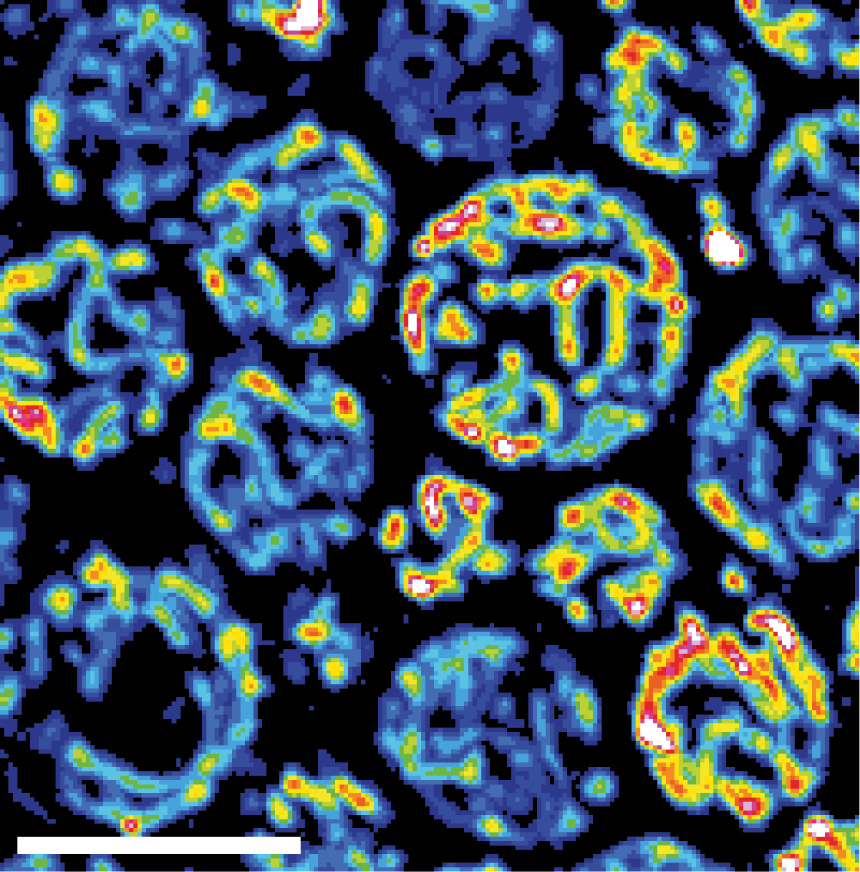
The mitochondrial network is shown in yeast cells. The reddish coloring indicates the fitness of the mitochondria. N. Photograph: Vögtle/ZMBH
“How Do Mitochondria Detect Danger Before Cellular Dysfunction Becomes Visible?”
Researchers from the University of Freiburg and Heidelberg University have identified a new mitochondrial early-warning system against oxidative stress.
The study was led by Prof. Dr Chris Meisinger, University of Freiburg, and Prof. Dr F.-Nora Vögtle, Heidelberg University. The first authors are Asli Aras Taskin and Sahana Shankar.
The team demonstrates that mitochondria can sense mild oxidative stress before visible cellular damage occurs. Under low-stress conditions, two mitochondrial protein-processing enzymes lose activity, leading to the formation of protein aggregates inside mitochondria. These aggregates function as internal alarm signals that activate the mitochondrial unfolded protein response (UPRmt).
The findings suggest that mitochondria are not passive victims of cellular stress, but active surveillance systems capable of initiating protective adaptation at very early stages.
Impact
The study reinforces a growing concept in mitochondrial medicine: pathology may begin not simply with mitochondrial failure, but with the disruption of mitochondrial sensing and adaptive signaling mechanisms.
A Conceptual Shift in Biology
This work marks a transition from a static view of mitochondria toward a systems-biology perspective, where mitochondria act as active coordinators of cellular decisions under stress.
The emerging question is no longer only:
“What happens when mitochondria are damaged?”
But increasingly:
“How do mitochondria detect danger before cellular dysfunction becomes visible?”
Statement from the World Mitochondria Society
According to Prof. Volkmar Weissig, President of the World Mitochondria Society, and Prof. Marvin Edeas, Chairman of the World Mitochondria Society:
“This study is not simply another mitochondrial dysfunction paper. It introduces the idea of intra-mitochondrial surveillance, which is highly aligned with the WMS conceptual evolution from: ‘What fuels mitochondria?’ to ‘What controls mitochondrial behavior?’”
Reference
Asli Aras Taskin, et Al, “Uncovering the Initial Response: Intra-mitochondrial Surveillance Activates the UPRmt.” Molecular Cell, 2026.
DOI: 10.1016/j.molcel.2026.05.002.